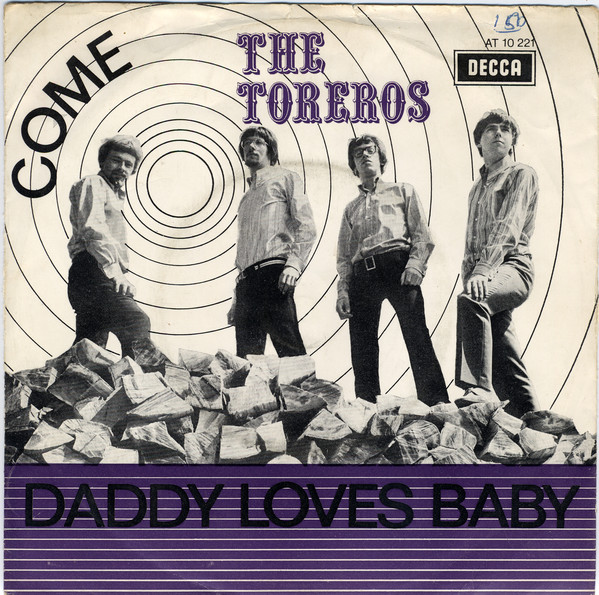
“Daddy Loves Baby” (1966) – The Toreros * Written by Don Covay * 45: “Come” / “Daddy Loves Baby” * Label: Decca The Toreros, from the Netherlands, materialized in the early sixties under the spell of the Shadows’ Iberian motifs and echoing guitars. A 1966 single found them at a longhaired crossroads. Hollies or Stones? Side A proposed the former, while side B argued for the latter. That B side, “Daddy Loves Baby,” stands as the band’s best record, turning Don Covay’s suave, soft-shoe original into prime garage band stomp fodder. When you add Frank Sinatra’s 1957 “Baby Won’t You Please Come Home” to the timeline, a song that ends with Sinatra’s own “Daddy loves baby” statement, the Toreros find themselves at the two-levels-of-deevolution mark. To their credit.
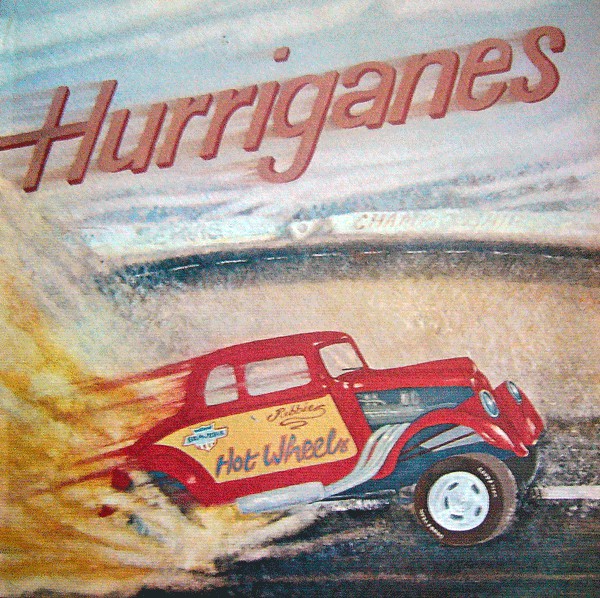
“Kenny at the Corner” (1976) – Hurriganes * Written by Remu Aaltonen and Cisse Häkkinen * Produced by Hurriganes * LP: Hot Wheels * Label: Love
Hurriganes were the rockabilly figureheads of Finland, that permanently ’50s-crazed nation, but they’re also linguistically fascinating in that they shone the spotlight on — and celebrated — their shaky grasp of English. During the tankeros ’70s, such a quirk had marketing magic. Their band name spelling replaced what Finns heard as a weak K sound in the English word “hurricanes” with a G, and drummer/vocalist Remu Aaltonen barked confidently on every song, using any word combo, regardless of sequitur status, that raced through his mind. The song “Kenny on the Corner” from their 1976 Hot Wheels album is a worthy example, among many.
“Ode to Billie Joe” (1967) – King Curtis and King Pins * Written by Bobbie Gentry * Produced by Tom Cogbill and Tom Dowd * 45: “Ode to Billie Joe” / “In the Pocket” * Label: Atco * Charts: Billboard Hot 100 #28; R&B #6 Bobbie Gentry’s breakthrough single, in the summer of ’67, made for one of those pop music moments where every ear seemed bent toward a specific song. Gentry sang gently about an apparent suicide and some undisclosed item being thrown over the Tallahatchie Bridge. She gave more info about events surrounding the telling of the tale (multiple servings of apple pie and biscuits) than she did about the tale itself. More notably, the music churned irresolutely–a lone nylon string guitar went back and forth between 9th and 7th chords while four violins and two cellos swirled into the ether and then back around.
The record made an impression on country music, proposing a Gothic approach that, on one hand, went against its audience’s culture of certainty, but on the other, paid tribute to the abiding darkness in Appalachian folk song. Soon Dolly Parton was singing about jumping from “The Bridge” with an unwanted child and Charlie Rich was reporting on the mysterious events of “July 12, 1939,” and all of Tanya Tucker’s first singles bumped Gentry on the shoulder while reaching for William Faulkner.
The best responses came from (runner up) Bob Dylan, whose “Clothesine Saga” on the Basement Tapes is his funniest song, carrying on about laundry en route to the primary revelation that the “Vice President’s gone mad,” and (winner) sax legend King Curtis, who rounded up all the spookiness, scrapped the lyrics altogether, and left us with an even more enticing mystery.
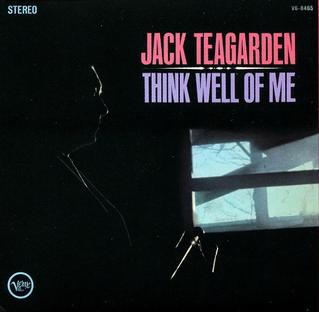
“Don’t Smoke in Bed” (1962) – Jack Teagarden * Written by Willard Robison * Produced by Creed Taylor * Arranged by Bob Brookmeyer * LP: Think Well of Me * Label: Verve Willard Robison was among the noir-est of classic songwriters but with an American Gothic twist, thanks to his rural imagery. Jack Teagarden, the singular trombonist and vocalist from very rural Vernon, Texas, released a collection of Robison songs called Think Well of Me late in his career, and it comes off as something that had to happen. Bringing his own country-to-city boy background to the material, his weary voice sounds like what Robison may have had in mind during the writing process for each song. (The opener, strangely, is “Where Are You,” the only one in the twelve-cut lineup not written by Robison.) “Don’t Smoke in Bed” is a song that had been done previously by Peggy Lee in the late forties (with strings and an echoing/fading goodbye phrase near the end) and Nina Simone in the late fifties (with lonely piano and voice). They’re effective versions, but Teagarden’s is the odd standout in voicing the perspective (male) of the one who has been left, rather than the perspective (female) of the one leaving. Bob Brookmeyer’s string arrangements fill the air with foreboding harps and, whenever the title phrase gets uttered, violins rise upward like flames. You feel resigned when listening that not only will there be smoking in bed, but a match will also be struck and dropped on the sheets outright. (Bob Dylan almost certainly found inspiration in this entire album when he got working on his moody Americana-tinged standards collection Shadows in the Night.)
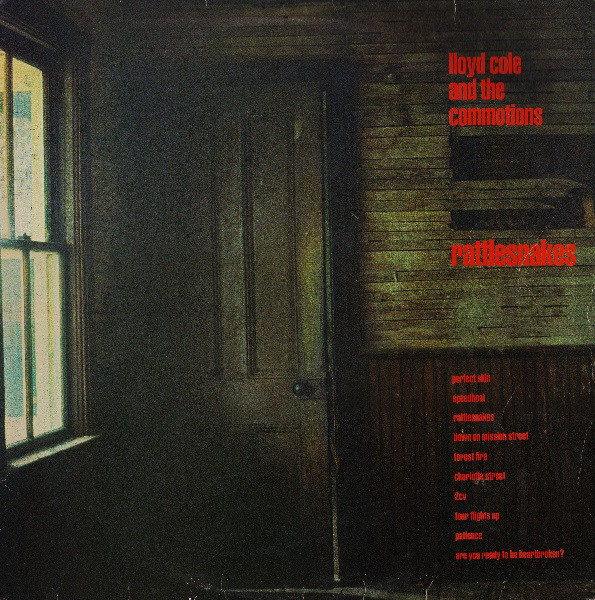
“Are You Ready to Be Heartbroken?” (1984) – Lloyd Cole and the Commotions * Written by Lloyd Cole and Neil Clark * Produced by Paul Hardiman * LP: Rattlesnakes * Label: Polydor “Are You Ready to Be Heartbroken?” was the final track on the debut album by the University of Glasgow’s Lloyd Cole and the Commotions, and it jangled with a rich, resonant sadness. Anne Dudley’s string arrangements swelled up like big tears, offsetting and forgiving Cole’s snooty set of lyrics. There’s no reason not to suspect the song started as a goof on Glaswegian jangle rival Roddy Frame, who wore his adoration for Arthur Lee on his sleeve, whose wordiness might have benefited from some bookish discipline (or a cold, hard peek through Gary Gilmore’s eyes via Norman Mailer), and whose cheerfulness and need for a sartorial re-think all made themselves manifest in his early publicity shots and videos. Whatever the inspiration, and to their credit, the black-turtlenecked Commotions allowed their song to take on an emotionally layered life of its own. A 2006 track by the Scottish group Camera Obscura (“Lloyd, I’m Ready to Be Heartbroken”) vied for the Most Unnecessary Answer Song award.
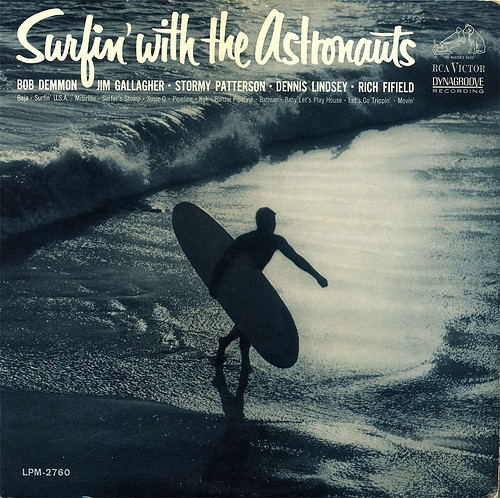
“Baja” (1963) – The Astronauts * Written by Lee Hazlewood * 45: “Baja” / “Kuk” * LP: Surfin’ with the Astronauts * Label: RCA Victor * Charts: Billboard Hot 100 #94 “Baja” was the only charting single for the Astronauts, who conjured up surf music from Boulder, Colorado. The track’s exquisite moodiness suggested that the farther away you were from an actual scene, the better your chances might be to imbue it with mythical qualities. Lee Hazlewood, who produced, wrote for, and helped craft the legendary guitar sound of Duane Eddy, had written “Baja” for a shelved album with the L.A. studio aces he referred to as his “Woodchucks.” Guitarist Al Casey then released an OK version of “Baja” in ’63, produced by Hazlewood, which angled for a “Lonely Bull” feel minus the prominent “olé” shouts that pepper one of the original Woodchuck demos. For the Astronauts’ reading, it’s clear they also used the Hazlewood demos as a source (as opposed to the Casey record), borrowing the approach of giving the upper register guitar line a lower register answer. Where surf music from the era, including Hazlewood’s, can sound overly tick-tocky, the Astronauts’ version is light on its feet, as though dashing through the kind of twilight ocean spray their Surfin’ with the Astronauts album cover promises. The album features two additional tracks (“Movin'” and “Batman”) they’d taken from the Hazlewood tapes which, incidentally, were finally dusted off and issued in 2018 as Cruisin’ for Surf Bunnies and billed to “Lee Hazlewood’s Woodchucks.” (Side B of the Astronauts’ “Baja” single features the only song on the album actually written by the band.)
“I Wanna Be Your Boyfriend” (1978) * Written by Tommy Dunbar and James Gangwer * 45: “I Wanna Be Your Boyfriend” / “Gorilla” * LP: Back to the Drawing Board * Label: Beserkley
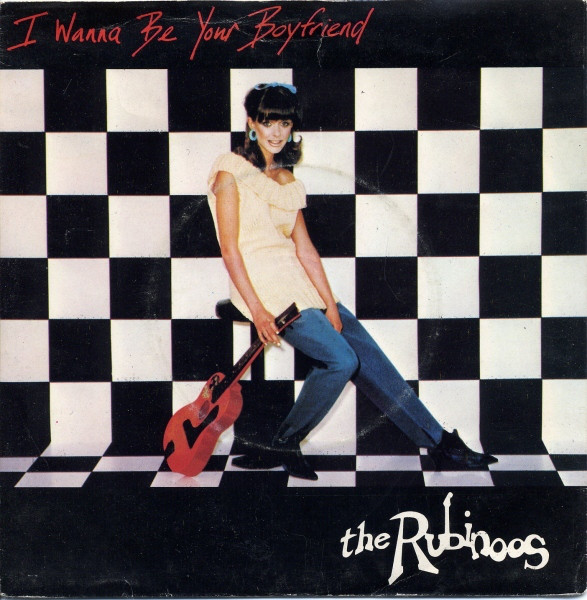
The power poppers of the seventies wore their inspirations like musical lapel pins, proudly adopting key hooks from the sixties British Invasion for their own purposes. But tribute, like parody, raises copyright questions. (In his Always Look on the Bright Side of Life, Eric Idle recounts playing the Rutles tracks to his pal and cheerleader George Harrison, who made it clear that composer Neil Innes had, alas, entered the copyright danger zone.) When the San Francisco Bay area’s Rubinoos sang “Hey! You! I wanna be your boyfriend,” they managed to pay their respects to both the Rolling Stones, by nabbing the key hook from their “Get Off My Cloud,” and the early Beatles, by using it in service of lovelorn tunesmithery. (Incidental advice to the Rubinoos: try addressing the girl by her name.) So when Avril Lavigne sang “Hey! You! I wanna be your girlfriend” in 2007 and had a radio-drenching #1 hit, songwriters Tommy Dunbar and James Ganwer had no choice but to make legal inquiries, seeing that anyone who knew their tune from 1978 assumed the existence of some sort of arrangement. No, none were made and none would be made. The defendants’ response: didn’t you steal your hook from the Stones?
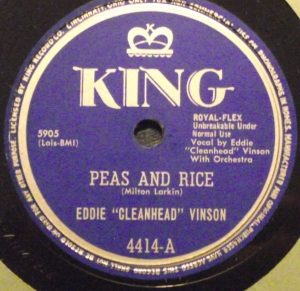
“Peas and Rice” (1950) – Eddie “Cleanhead” Vinson * Written by Milton Larkin * 78: “Peas and Rice” / “If You Don’t Think I’m Sinking (Look What a Hole I’m In)” * Label: King “Kidney Stew Blues,” from 1947, is the best-known track by the Houston, Texas-born alto sax-blowing blues shouter Eddie “Cleanhead” Vinson. It’s “Peas and Rice,” though, the follow-up menu offerering written by the Navasota-born bandleader Milt Larkin, that really showcases the signature rasp-gasp Vinson would use for phrase endings. (His nickname comes from an early misadventure with some destructive hair-straightening product, according to a 1975 interview in Blues Limited magazine. After shaving his head he enjoyed the attention brought on by the new look.) The first appearance of “Peas and Rice” on LP was on a 1959 King label compilation called Battle of the Blues Vol. 4, which includes tracks by Vinson, Roy Brown, and Wynonie Harris. Information about the two female cover models with boxing gloves remains elusive.
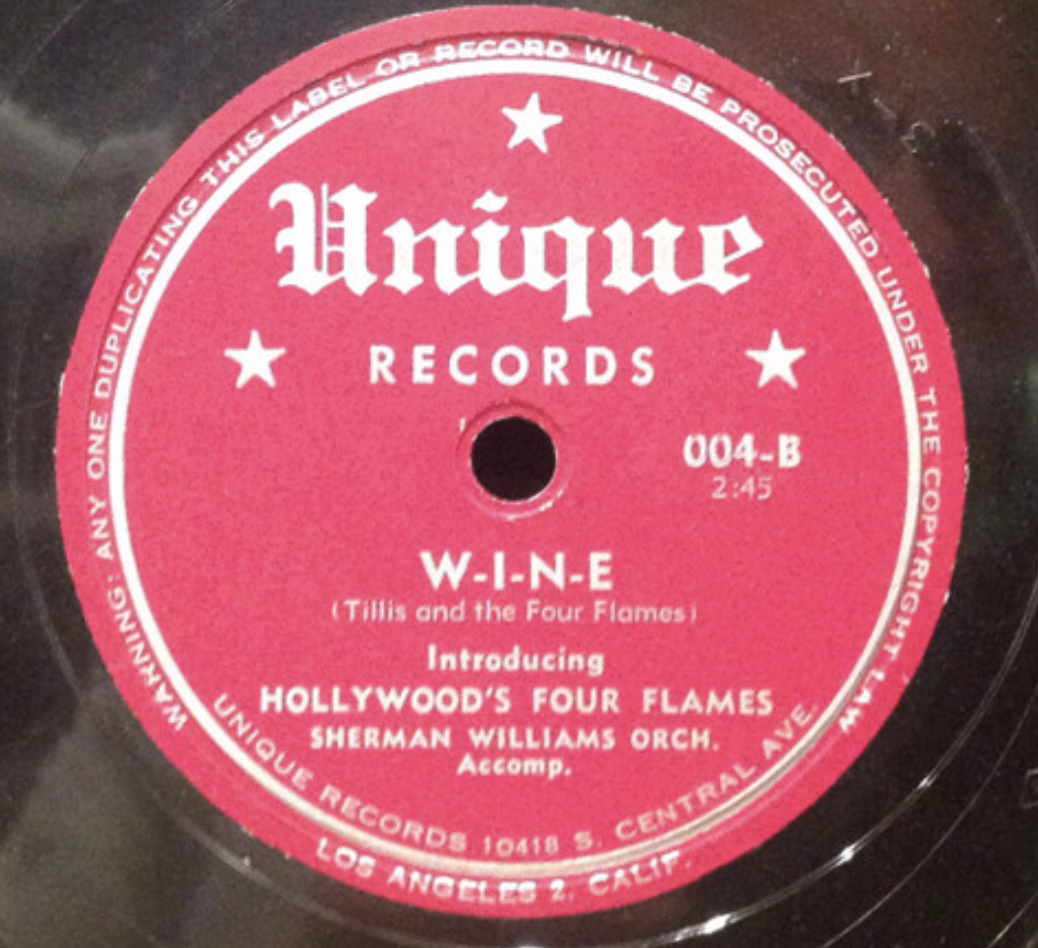
“W-I-N-E” (1951) – The Hollywood’s Four Flames * Written by Clyde Tillis * 45: “Dividend Blues” / “Wine” * Label: Unique The Hollywood’s Four Flames featured vocalists Bobby Byrd, Earl Nelson, and Clyde Tillis (each of whom later made records under their own names), and went by a number of similar collective monikers. The “Famous Flames” was the best-known of these, thanks to their late-fifties inclusion of a young James Brown. Confusingly, the singer Bobby Day (“Rockin’ Robin”) had the given name Robert Byrd, and he sang in a group called the Hollywood Flames (“Buzz Buzz Buzz”), so he’ll sometimes, erroneously, get mixed into histories of Bobby Byrd’s group. As for our song in question, it finds a chronological wine-jive slot right between Stick McGhee’s “Drinkin’ Wine Spo-Dee-O-Dee” (1949) and Floyd Dixon’s “Wine, Wine, Wine” (1952), later to be followed up by offerings from Three Aces and a Joker (“Booze Party,” 1960) and the Nightcaps (“Wine, Wine, Wine,” 1962). The first release of this record on Unique, as the B-side to “Dividend Blues” on 78, lists it as “W-I-N-E,” although the 45 version has none of those hyphens. (The vocals don’t ever spell it out, either.) The re-release on Fidelity that same year is also hyphenated. Be sure to listen until the handclaps hook you in at the 40-second mark.
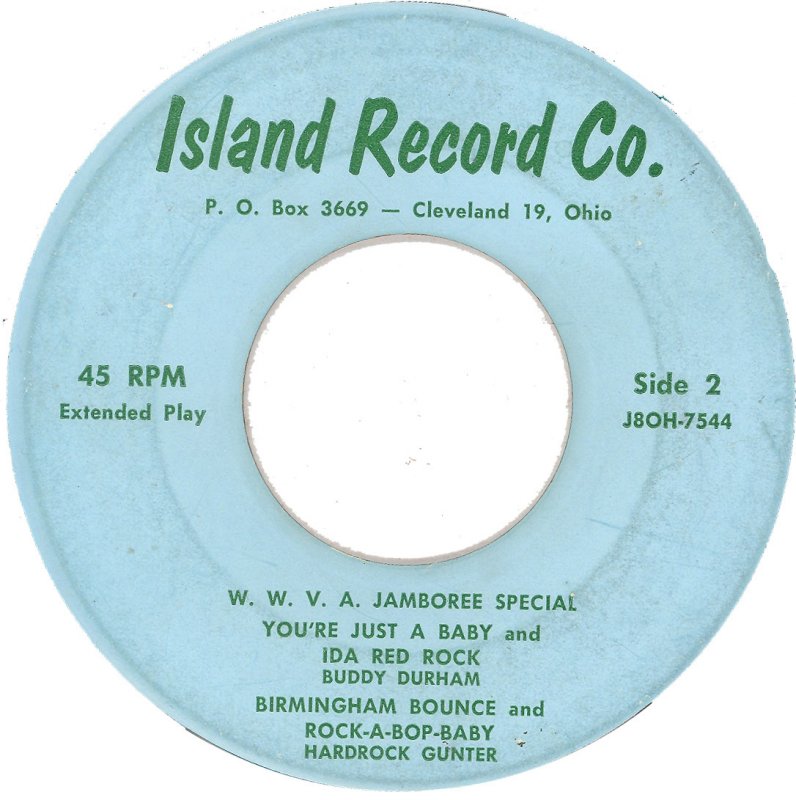
“Birmingham Bounce” – Hardrock Gunter (1958) * Written by Hardrock Gunter * EP: “Gonna Be a Fire”/”Down in the Holler Where Sally Lives” (Bill Browning) “Juke Box Play for Me”/”You Gotta Go” (Cook Brothers) “You’re Just a Baby”/”Ida Red Rock” (Buddy Durham) “Birmingham Bounce”/”Rock-A-Bop Baby” (Hardrock Gunter) * Label: Island Alabama’s Sidney Gunter Jr.—given his better-known nickname “Hardrock” after a truck’s hood clonked him on the head with no damage done—secured an eventual slot in the rock ‘n’ roll Pantheon with his 1950 single “Birmingham Bounce,” a vintage specimen of R&B + hillbilly coexistence. That same year Red Foley turned his version of the song, which would become Gunter’s lifelong calling-card, into a top-selling country hit. Seminal as Gunter’s own 1950 record is, his 1958 redo for Cleveland’s Island Record Co. on a jam-packed 8-song sampler EP jumps out as one with special attention-getting electricity, thanks in part to his newfound taste for slapback echo (which had inspired him, a year before, to try out a version of “We Three (My Echo, My Shadow and Me)”). Since 1950, Gunter kept pumping out records for various labels, including the new rock-royal Sun, until retiring from the music business in the mid-sixties (and resurfacing momentarily for the avid European rockabilly community in the late ’90s).