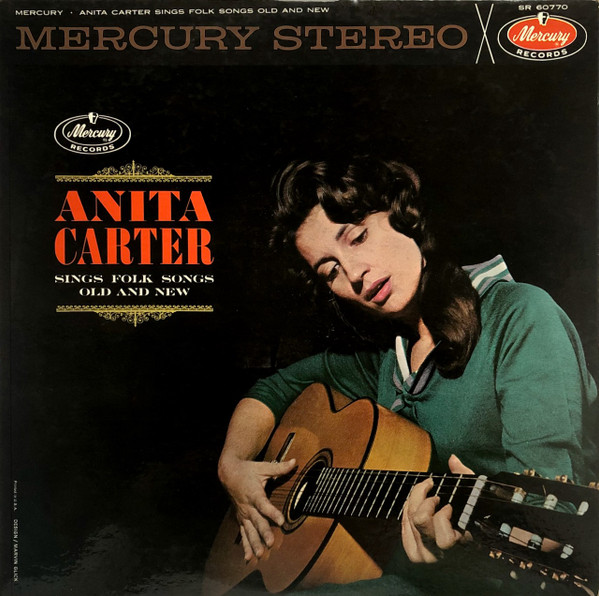
“Voice of the Bayou” (1962) – Anita Carter

“Voice of the Bayou” (1963) – Anita Carter * Written by Robert L. (Bob) Johnson *  Produced by Shelby Singleton * LP: Anita Carter Sings Folk Songs Old and New * Label: Mercury

Anita Carter, who sang with the Carter Sisters and Mother Maybelle, released a folk album in December 1962 called Anita Carter Sings Folk Songs Old and New, and it’s haunted by both heaven and hell. In the grooves, her voice is heard lilting on wintery winds, while on the cover, she looks like Loretta Lynn’s sister in the middle of her guitar lesson. The record’s especially notable for containing the first recorded version of her actual sister June’s “Ring of Fire,” listed on the album as “Love’s Ring of Fire.” (More on this in a future post.)

Among the album’s most haunting tracks (which is saying something, seeing that it closes with Danny Dill’s “Satan’s Child”) is a voodoo number called “Voice of the Bayou.” Written by Bob “Bobby Region” Johnson, a banjo player for the Lonesome Drifters, and also for Bill Monroe and Norman Blake (that nickname of his is a trad folk accolade), the song tells of a “voodoo queen” who’s “waitin’ all alone… on her throne” to claim Anita’s man. Anita, though, will be making her own doll to stick “full of pins,” and “when the moon is dark as blood,” the voodoo queen’s “troubles will begin.”

Among the song’s enchantments is, in fact, a chant that Carter sings throughout. Lyric references spell it out as “um-a-pa palesu-va.” Bob Johnson is no longer with us, but I’m guessing that if he were asked about it, he would say he was merely trying to approximate a regional sounding incantation. I found an assertion elsewhere on the Internet that Anita is singing ancient Hebrew words (“uma-pavel-azamah,” or “glory of the humble flame God has helped”).

Even in a Bible Belt context, this feels like a stretch for a story about a voodoo fight. A more feasible translation, considering that Anita is singing recognizable French words and pronunciation in a Creole setting, is “où ne m’a pas parlé, je vas,” which means “where no one has spoken to me, I go.” But I’m still betting that Johnson just concocted something.

Producer Shelby Singleton, incidentally, must have given this track some local juju of his own, having grown up in Shreveport.
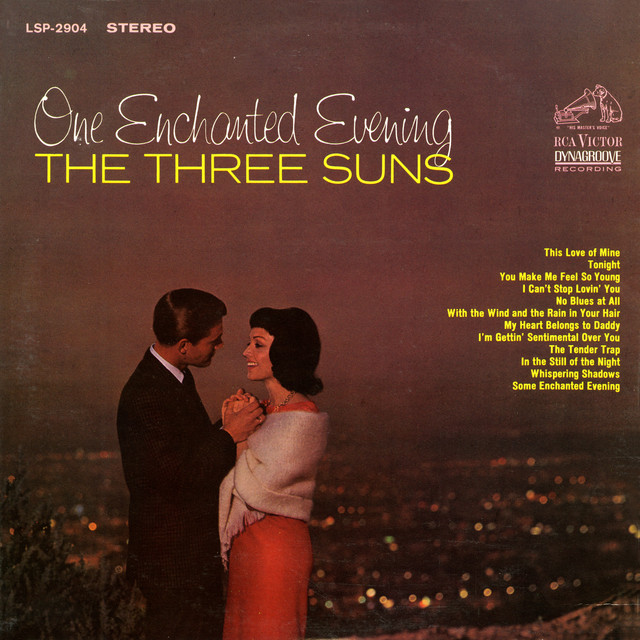
“Some Enchanted Evening” (1964) – The Three Suns

“Some Enchanted Evening” (1964) – The Three Suns * Written by Richard Rodgers and Oscar Hammerstein II * Produced by Al Nevins * Arranged by Roy Glover * LP: Some Enchanted Evening * Label: RCA Victor

This is the title track from an album that has never sounded hip, even considering that the Three Suns, armed with organ, accordion, and guitar, eventually found the favor of record collectors under the auspices of both irony and sincerity. Many surprises and pleasures do exist in their 40-plus album oeuvre, but this one, at the tail end of their run, will make you feel as if you’ve barged in on the amours of a couple who have just removed their polyester. What caught my ear was the organ riff at 2:39. Was this the idea of trio member Artie Dunn or arranger Roy (LeRoy) Glover? Because it foretells the instrumental hook of the Temptations’ “I Wish It Would Rain” a good three years before that single would saturate Top 40 radio.

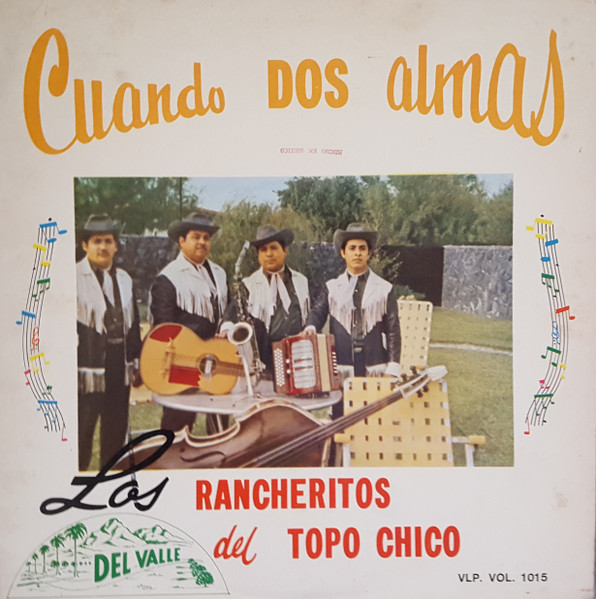
“Serenata Norteña” (1964) – Los Rancheritos del Topo Chico

“Serenata Norteña” (1964) – Los Rancheritos del Topo Chico * LP: Cuando Dos Almas * Label: Del Valle.

I listened to Los Lobos’s How Will the Wolf Survive so much in 1984 (and beyond) that I don’t really even need to listen to it anymore. I can just play it back with accuracy right up there in my noggin. I always wondered about “Serenata Norteña,” though, a grito-peppered polka track sung in Spanish that breaks down into a waltz during the choruses. For me, it unlocked a door for a long-abiding adoration for canciones tradicionales mexicanas, and I’ve wanted to know about the song’s origins. On the label, though, it says “copyright control” where the writers ought to be. This a term that expresses more doubt than the standard “traditional” or “public domain,” as though the artists suspect it has a traceable origin but they just couldn’t figure it out.  

Imagine my surprise and delight, then, when a record I found in a San Antonio flea market by Los Rancheritos del Topo Chico (yes, the same part of Monterrey in Northern Mexico where the bubbly water comes from), unrolled the very arrangement, circa 1964, that Los Lobos were to use decades later. This record came out on the Del Valle label in McAllen, Texas, and another group on that same label, called Hermanos Hernandez, happened to record a single with the same name, but it’s altogether different. No writers are credited on the Los Rancheritos record, though, so my dead end is the same one Los Lobos already knew about. Los Rancheritos’ founder and lead vocalist Catalino Leos kept on making music until he passed away in 2024. 

Annoyingly, A.I. and its enablers plug in the names of various members of Los Lobos as the writers wherever one seeks.

Awesomely, polka king Frankie Yankovic included a medley of “Corrida #1” and “Serenata Norteña” on his 70 Years of Hits album in 1985. 

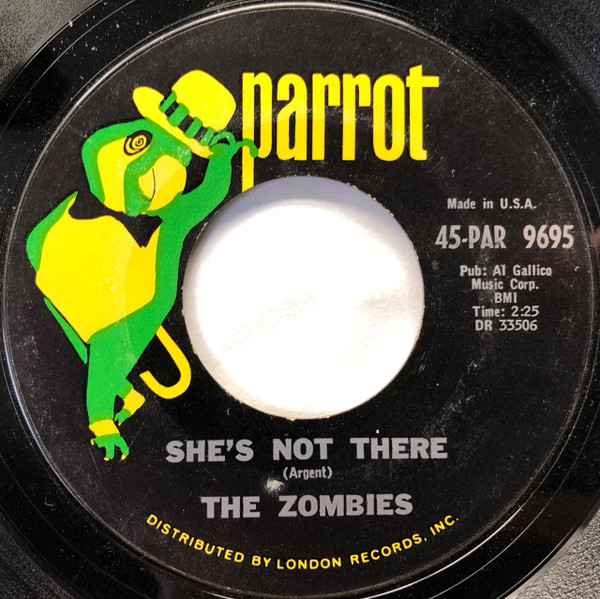
“She’s Not There” (1964) – The Zombies

“She’s Not There” (1964) – The Zombies * Produced by Ken Jones (Marquis Enterprises) * Written by Rod Argent * 45: “She’s Not There” / “You Make Me Feel Good” * Label: Decca (UK) / Parrot (US) * Charts: Billboard (#2); UK (#12). 

Released amid the grins and frolics of 1964’s British pop music imports, “She’s Not There” stood out for its foggy shroud and minor key. Hugh Grundy’s drums kick and click in secret code. Rod Argent’s organ (a Hohner Pianet) slinks about under Colin Blunstone’s voice-on-the-wind words about a series of situations—causing more than one person to cry—that no listener can really figure out. (For some fun, go read entries on songmeanings.com, some of which hypothesize about it referring to incidents that happen long after the song was released.) “Why should I care?” sings Blunstone, who’s all counterculture sunglasses in a dark and smoky room, his insouciance masking the sting.

Tenses and points of view shift out of sync, while contextual clues, like the woman in the song, never appear. This sense of mystery is crucial to the song’s allure and gives it ongoing callback utility for anyone feeling bewildered by the non-presence of a certain female. Rod Argent reportedly drew his inspiration from John Lee Hooker’s organ-juiced “No One Told Me.” The US Parrot version mislabels the B-side as “You Make Me Feel So Good.”

Notable cover versions: Ola and the Janglers, UK Subs, Santana, Neko Case and Nick Cave.

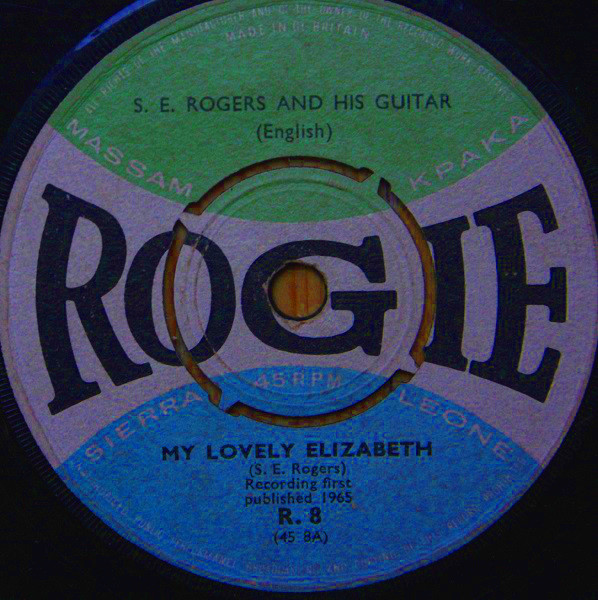
“My Lovely Elizabeth” (c. 1962) – S.E. Rogie and His Guitar

“My Lovely Elizabeth” (c. 1962) – S.E. Rogie and His Guitar* Written by S.E. Rogers * 45: “My Lovely Elizabeth” / “Advice to Schoolgirls” * Label: Rogie

Here’s an ideal representation of the West African “palm-wine” genre, so named for its suitability for having a nice tropical drink while you listen. Sierra Leone’s S.E. Rogie (Sooliman Ernest Rogers, d. 1994), in spite of the laid back impression his music conjures, was rather industrious, launching his own label in the early sixties and working its distribution. “My Lovely Elizabeth” was his first big seller – the label image above contains the frustrating note that it was “first published in 1965,” although other sources claim that the record had been floating around as early as 1962 and that his sound had changed quite a bit by 1965.

Here’s what Gary Stewart says in his Breakout: Profiles in African Rhythm (1992, p. 48): “Rogie’s biggest record of the early days was the 1962 hit ‘My Lovely Elizabeth’ … [it] sold an estimated thirteen thousand copies in Sierra Leone (an astonishing figure for the time given that record players were, for the most part, the property of more affluent city dwellers in a country whose population was largely rural) and thousands more when EMI picked it up for international distribution … Suspicious of EMI’s sales figures and disappointed in their royalty payments, he reverted to doing his own distribution.”

Side B contains Rogie’s “Advice to Schoolgirls,” in which he recommends, along with the virtues of honesty and staying true to one’s dreams, the avoidance of prostitution.

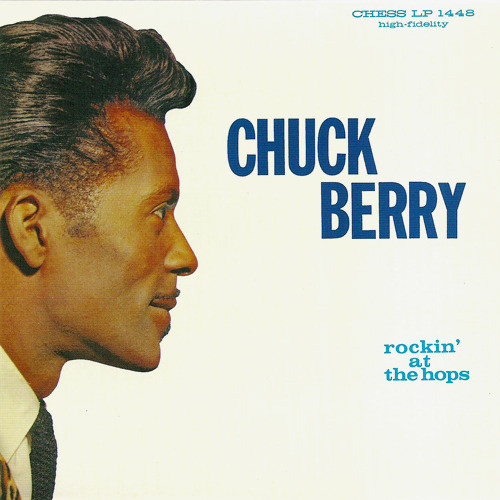
“Bye Bye Johnny” (1960) – Chuck Berry

“Bye Bye Johnny” (1960) * Written by Chuck Berry * 45: “Bye Bye Johnny” / “Worried Life Blues” * LP: Rockin’ at the Hops * Label: Chess

“Johnny B. Goode” (1958) is both the official anthem of rock ‘n’ roll and its unofficial folk song, telling the story of a musical country boy hitting the big time. Like with so many of Berry’s songs, it’s hard to imagine something so all-encompassing being a documented human creation. Although it’s clear Chuck Berry was singing about a version of himself (he reports in his autobiography that “country boy” was first slated to be “colored boy”), part of its fascination has to do with him also narrating a version of the Elvis myth as it unfolded. As Dave Marsh wrote in The Heart of Rock and Soul, “if you could identify with either Presley or Berry” when listening, “there was a chance you could identify with both.”

The 1960 sequel “Bye Bye Johnny” appeared the same year Elvis returned from the Army, after which he’d focus on the “motion pictures out in Hollywood” phase of his career, just as Johnny was about to do. The “bye bye” sentiment in the title refrain referred directly to Johnny leaving home, but it had more to do, presciently and symbolically, with a sort of departure from pure musicality and therefore authenticity—the notion of “movie/TV stink” that’s arisen in these pages—that we would see in Elvis. With “Bye Bye Johnny,” Chuck Berry is singing about how the rise is the fall, the essential pop music success conundrum.

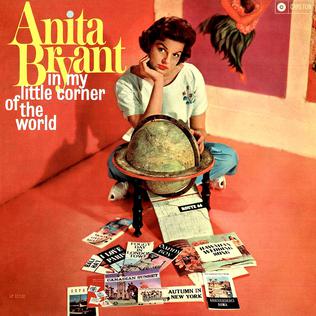
“In My Little Corner of the World” (1961) – Anita Bryant

“In My Little Corner of the World” (1960) – Anita Bryant * Written by Bob Hilliard and Lee Pockriss * Produced by Lew Douglas * 45: “In My Little Corner of the World” / “Anyone Would Love You” * LP: In My Little Corner of the World (1961) * Label: Carlton * Charts: Billboard (Hot 100, #10)

Anita Bryant’s top ten recording of “In My Little Corner of the World,” produced by Lew Douglas and arranged by 101 Strings stalwart Monte Kelly, transcended its humble lyrical implications. All participants aimed for the cosmos. We forget how big and commanding Bryant’s voice was and how well-matched it sounded alongside the lavish pop orchestrations of the day. (A follow-up album went for a “songs about the world” theme.) But our thoughts inevitably drift toward her late ’70s anti-gay activism, her fearful “human garbage” utterances, and then satires begin writing themselves: “In My Little Corner of My Brain,” “My Little Corner of the World is the Only Corner of Any Value,” etc.  The song title also morphs into a self-indicting syndromic label for the Oklahoma native Bryant’s human rights-challenged corner of the U.S. We struggle not to stroke the brush broadly in this way. Many cover versions of this song have sprouted elsewhere, most of them truer in lyrical sentiment, and therefore less spectacular.  Marie Osmond (who had also updated Bryant’s “Paper Roses”) recorded a cuddly country version in 1974, while Yo La Tengo sang it from a proper corner in 1997.

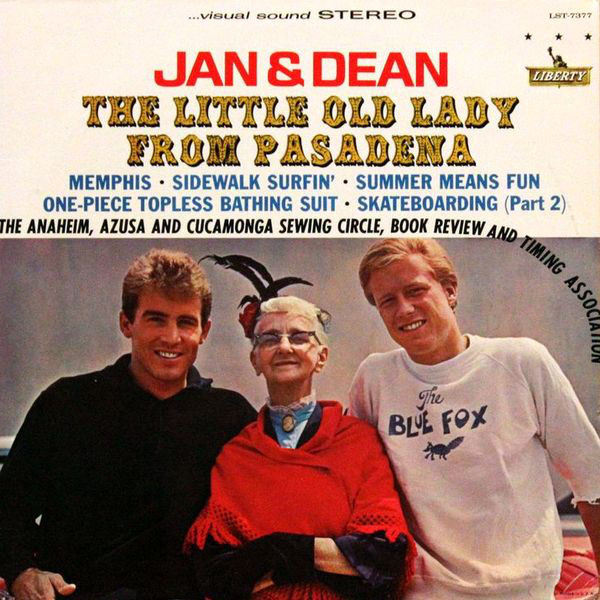
“The Little Old Lady from Pasadena” (1964) – Jan and Dean

“The Little Old Lady from Pasadena” (1964) * Written by Don Altfeld, Jan Berry, and Roger Christian * Produced by Jan Berry * LP: The Little Old Lady from Pasadena * 45: “The Little Old Lady from Pasadena” / “My Mighty G.T.O.” * Label: Liberty * Charts: Billboard Hot 100 (#3)

Jan and Dean’s “Little Old Lady from Pasadena” rode in the slipstream of a commercial campaign featuring Kathryn Milner as a high-speed Dodge driver. Lyricist Roger Christian did penance for his role in the Beach Boys’ “Shut Down”—where he had depicted a Chevy outpacing a Dodge—by celebrating Dodge’s popular ad mascot. The mythical “old widow in Pasadena” with a set of barely-driven wheels in the garage was by then a California car lot cliché, but where are its origins? Perhaps the first mention of it appears in the 1953 theatre cartoon Magoo Slept Here, in which the near-sighted hero boasts of getting his antique TV (actually a washing machine) from an “elderly lady in Pasadena.” A different archetype in the song is Jan Berry’s bored, vibrato-free Cali-teen drawl, which you later hear in everything from early Black Flag to Green Day to Blink 182.  Wrecking Crew regular Tommy Morgan is likely playing the harmonica, giving it a backwoods flavor that also summons the familiar character of Granny in The Beverly Hillbillies. (Dean Torrance’s “Blue Fox” sweatshirt advertises a Tijuana bar with a sleazy reputation, foretelling the duo’s 1967 rewrite of “Little Old Lady from Pasadena” as “Tijuana,” which turns her into a narcocorrido metaphor.)

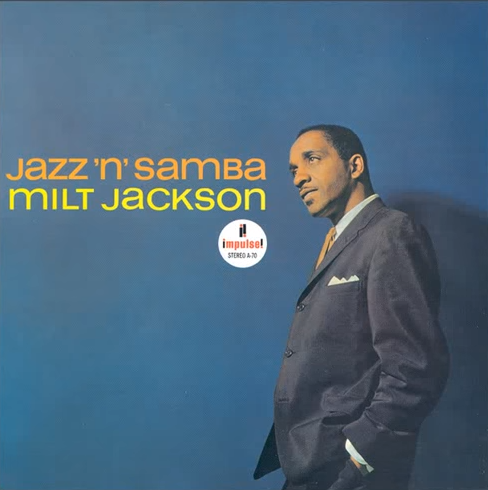
“The Oo-Oo Bossa Nova” (1964) – Milt Jackson

“The Oo-Oo Bossa Nova” (1964) – Milt Jackson * Written by Manny Albam* Produced by Bob Thiele * Label: Impulse

“Ooh ooh” and “do you mind?” were catchphrases for Joe E. Ross on Car 54, Where Are You? (1961-1963), a Nat Hiken sitcom with a “character actors on parade” quality. Each player specialized in facial distinctions that made it hard for viewers to turn away. Fred Gwynne and Al Lewis of The Munsters were there, for example, each of whom actually look more interesting without their makeup. Joe E. Ross, who played the dimwitted but loveable officer Gunther Toody, might also have transitioned nicely to The Munsters, but he was apparently a severe headache to work with.

Two records helped to capture Ross’s pop culture moment. The first is the 1963 single “Ooh Ooh,” featuring him delivering those catchphrases with a stock rock track and nyah-nyah girl chorus, something that would have fit in well for a hypothetical episode calling for Toody to launch an ill-advised recording career.  The second, though, is an album track by the suave jazz vibraphonist Milt Jackson (written by Manny Albam) called “The Oo-Oo Bossa Nova,” which appeared on Jackson’s 1964 Jazz ‘N’ Samba album a year after the show had run its course. (Producer Bob Thiele, while at Impulse, always kept an eye open for the commercial tie-in).

The jazz journalist Leonard Feather, in his liner notes, points to the song’s kinship with “Who’s Got the Pain (When They Do the Mambo)” from Broadway’s Damn Yankees. The gatefold features an image of Joe E. Ross in the studio recording this record’s oo-oo‘s, which would perhaps be his final high-profile Car 54 utterances.

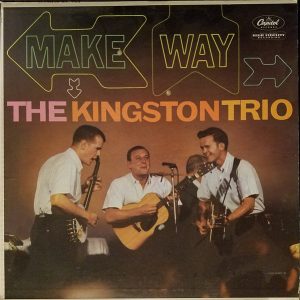
“Utawena” (1961) – The Kingston Trio

 
“Utawena” (1961) – The Kingston Trio * Written by Nick Reynolds and Adam Yagodka * Produced by Voyle Gilmore * LP: Make Way * Label: Capitol
 

Sketchy songwriting credits abounded during the folk revival, with interpreters taking ownership of traditional-sounding tunes as “version-composers.” This could complicate the act of tracking down a song’s proper origins. In the case of “Utawena,” a song on the Kingston Trio’s 1961 Make Way album, the credits go to Trio member Nick Reynolds and his friend Adam Yagodka. But it’s really an arrangement of a South African Kinswahili song called “Ut’he Wena,” which the two credited writers likely learned from the 1960 Schirmer publication Choral Folk Songs from South Africa, with arrangements credited to Pete Seeger and Robert DeCormier. Seeger had previously recorded a number of songs in that book on a 1955 album called Bantu Choral Folk Songs from the Song Swappers. “Ut’he Wena” isn’t included on the record, but its book arrangement shows that Reynolds and Yagodka had consulted it faithfully. (The book includes a translation.)

A thread at Mudcat Cafe about this song illustrates how frustrating origin-hunting can be for curious researchers, with the initiator reporting finding no answers from the Bear Family label’s box set notes, from Yagodka’s widow, and from Reynolds himself via phone, who claimed his memory had failed him. The initiator finally declares it a lost cause. (The recent group history Greenback Dollar: The Incredible Rise of The Kingston Trio by William J. Bush only calls the track “awful,” which it isn’t.) Another song on the Make Way album, “En El Agua,” is credited to Trio leader Bob Shane, but on the 1966 Best of the Kingston Trio, Vol. III, the label rightfully credits the then-living “Antonio Fernandez,” the real name of Cuban singer-songwriter Ñico Saquito. He had debuted the song in 1957 as “Maria Cristina.”