“Morning Girl” (1969) – Jim Pike


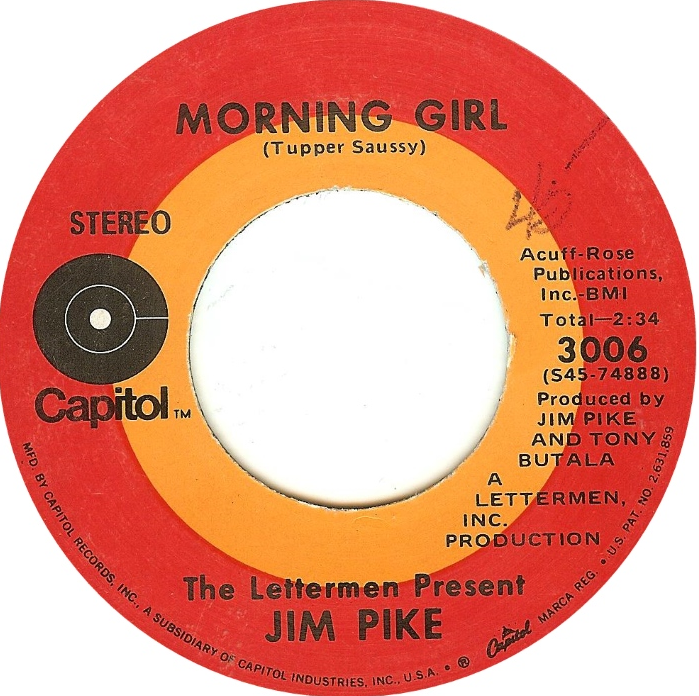
“Morning Girl” (1970) – Jim Pike * Written by Tupper Saussy * 45: “Morning Girl” / “Here, There and Everywhere” * LP: The Lettermen – Everything Is Good About You * Produced by Jim Pike and Tony Butala * Label: Capitol

Although the label on the Capitol 45 label and the chart listings all credited “Morning Girl” to the Lettermen’s Jim Pike, this version of the Neon Philharmonic’s #17 hit from 1969 eventually showed up on the 1971 Lettermen album Everything Is Good About You. Pike and fellow group member Tony Batula get credit for the production, which might imply that they also did the shimmering, Percy Faith-conscious string arrangement. This was the last chart entry for anything written by the Neon Philharmonic’s Tupper Saussy, although future teen idol Shaun Cassidy would release a version of “Morning Girl” as his very first single in 1975. The B-side featured a Pike rendition of the Beatles’ “Here, There and Everywhere” with more of the A-side’s alluring strings.

“Mandom – Lovers of the World” (1970) – Jerry Wallace

“Mandom – Lovers of the World” (1970) – Jerry Wallace * Written by Howard Cain and Mat Cain * Japan 45: “Mandom – Lovers of the World”/”Glory of My Woman” * Label: Liberty

Here’s a curious addition to the country pop singer Jerry Wallace’s resume, which also happens to be the biggest selling record of his career: a 1970 Japan-only jingle single that featured Charles Bronson on the sleeve. It was the soundtrack to a commercial for an aftershave called “Mandom,” starring Bronson as an urbane action figure who rewards himself at night by splashing the product all over himself like victory champagne. As he does this, Wallace gives the following lyrics one hundred-and-ten percent: “All the world loves a lover/All the girls in every land-om/And to know the joy of loving/Is to live in the world of Mandom.”

“If You Leave Me Tonight I’ll Cry” (1972) – Jerry Wallace


“If You Leave Me Tonight I’ll Cry” (1972) – Jerry Wallace * Written by Gerald Sanford and Hal Mooney * 45: “If You Leave Me Tonight I’ll Cry” / “What’s He Doin’ in My World?” * LP: To Get to You * Produced by Joe E. Johnson * Label: Decca

The TV show Rod Serling’s Night Gallery, which aired from 1969 to 1973, had a format similar to The Twilight Zone, with Serling as the host introducing creepy tales with twist endings. An episode called “The Tune in Dan’s Cafe” spawned the Jerry Wallace 1972 country #1 hit “If You Leave Me Tonight I’ll Cry.” The episode told the story of a jukebox that played the same record over and over again due to its being haunted by the ghost of a jilted lover. After the episode ran in January of ’72, radio stations received enough requests for the nonexistent record to prompt an official release by vocalist Wallace, who’d had moderate pop chart success until the mid-sixties, when he’d shifted gears to country. This overbaked hit version—barely listenable today—is sadly inferior to Wallace’s unavailable TV version, which had a harder country sound.

“Window Girl” (1970) – Luiz Bonfá


“Window Girl” (1970) – Luiz Bonfá * Written by Luiz Bonfá * LP: The New Face of Bonfá * Produced by Ernie Alschuler * Label: RCA Victor

Brazilian composer and guitarist Luiz Bonfá wrote the song of his career, “Manha de Carnaval, in 1959 for the Black Orpheus film. (Its many cover versions often show up as the “Black Orpheus Theme.”) He released three albums for RCA in the early seventies, with the first of these, The New Face of Bonfa, showing up on Los Angeles MOR powerhouse KMPC’s album airplay list. The lead-off track “Window Girl” showcased the 12-string guitar (a Giannini Craviola) that Bonfá was favoring at the time, although the flugelhorn of Alan Rubin took the lead. Bonfá, who did the arranging for most of the album, let Marty Manning do the honors on “Window Girl.”

“My Heart Just Keeps on Breakin'” (1973) – The Chi-Lites

“My Heart Just Keeps on Breakin'” (1973) – The Chi-Lites * Written by Eugene Record and Stanley (Stank) McKenney * 45: “My Heart Just Keeps on Breakin'” / “Just Two Teenage Kids (Still in Love)” * LP: A Letter to Myself * Label: Brunswick * Charts: Billboard Hot 100 (#92)

The early seventies saw an influx of hybrid genres and formats reflecting both a new cultural complexity and more sophisticated methods of audience analysis. The idea of “soul country” thus drifted about, with the massive success of Charley Pride—himself a hardcore country singer— raising questions about such a blend. Chicago’s Chi-Lites brought particular attention to themselves as “soul country” experimentalists, prompting a name check by Nashville promotional executive Chuck Chellman in the Music City News. He referred to recent adds of the Chi-Lites to country station playlists as evidence that country’s dalliance with rock music was leading to far greater travesties. Although their “Oh Girl,” with its laid back, harmonica-driven feel, may spring to mind as an example, it was a 1972 track called “My Heart Just Keeps on Breakin'”—a unique hodgepodge of barnyard fiddle, drawled vocals, Philly soul polish, pizzicatto strings and street corner doo wop—that made the strongest pitch. This was “soul country” if there ever was any.

“Morning Much Better” (1970) – Ten Wheel Drive featuring Genya Ravin

“Morning Much Better” (1970) – Ten Wheel Drive featuring Genya Ravin * Written by Michael Zager and Aram Schefrin * 45: “Morning Much Better” / “Stay With Me” * LP: Brief Replies * Produced by Guy Draper * Label: Polydor * Charts: Billboard Hot 100 (#74)

New Jersey’s Ten Wheel Drive competed with Chicago and Blood, Sweat and Tears in the thriving late-sixties/early-seventies jazz rock market, where band rosters could also function as fully-staffed softball teams. Among Ten Wheel Drive’s assets was singer Genya Ravin (formerly of ’60s girl group Goldie and the Gingerbreads), who was known to remove her upper attire and perform in body paint. Their lone charting single “Morning Much Better” now stands out for sounding like a precursor to the Family Feud TV game show theme, which debuted in 1976. Although that piece of music, written by Walt Levinski, doesn’t borrow any melodic ideas from the Ten Wheel Drive single, they both share a distinctive banjo and blaring horn DNA. Band member (and “Morning Much Better” co-writer) Michael Zager would later create the 1978 disco hit “Let’s All Chant,” while Ravin would produce Young, Loud and Snotty, the 1977 classic US punk debut LP for the Dead Boys.

“Are You Ready” (1970) – Pacific Gas and Electric

“Are You Ready” (1970) – Pacific Gas and Electric * Written by Charles Allen and John Hill * 45: “Are You Ready?” / “Staggolee” * LP: Are You Ready * Label: Columbia * Produced by John Hill

This Jesus-rock track became a 1970 #14 Billboard hit for the LA multiracial soul rock outfit Pacific Gas and Electric (who would need to change its name to PG&E by 1972 to avoid ire from the real life utility company.) The song begins by acknowledging the Vietnam War and ecological concerns (“There’s rumors of war/ Men dying and women crying/ If you breathe air you’ll die”) before stirring up a fuzzed out gospel choir frenzy. The end was nigh, warned the record, and the message must have resonated. The group featured lead vocalist (and Arthur Lee lookalike) Charlie Allen along with former James Gang guitarist Glenn Schwartz, who was likely responsible for their Godward tilt, having been converted to Christianity by street preacher Arthur Blessitt. (Known back then as the “Minister of Sunset Strip,” Blessitt is now remembered for having carried a cross through every nation of the world.) Did Schwartz feel sold out by the album cover? Did God rock, already popular at the time, really need sex to sell it? The 45 for “Are You Ready” gives co-billing to the Blackberries, a group of backup singers associated with the Motown label’s LA studio.

“Te juro que te amo” (1972) – Los Terrícolas


“Te juro que te amo” (1972) – Los Terrícolas * Written by Bruno Lauzi, Mogol, Oscar Prudente, and J. Ramirez * 45: “Te juro que te amo” / “Lloraras” * Venezuela LP: Lloraras * Label: Discomoda

Nowadays one will likely hear the Terricolas’ mid-seventies Mexican radio ballad, with its eerie sci-fi organ and disembodied female backing vocal, fighting through static on an AM station. The band name, which translates to the Earthlings, contributes to the record’s odd dimensionality. They were a group of young adults from Venezuela who released the record in 1972, then saw it get much bigger in 1975. Counterfeit versions of the original combo will occasionally surface in Latin American oldies circuits or mimed videos due to messy legal ownership of the name. The “Te juro que te amo” single had followed the familiar seventies procedure of reworking a European schlager hit to regional effect. This one had originally been a 1970 Italian hit for singer Michele (Maisano) as “Ti giuro che ti amo,” although the J. Ramirez who gave it Spanish lyrics is a puzzle. (Adapted from a previous post at Boneyard Media.)

“666” (1970) – Dave Bixby


“666” (1970) – Dave Bixby * Written by Dave Bixby * LP: Ode to Quetzalcoatl

Before breaking away in the early seventies, Dave Bixby belonged to an insular religious cult in Grand Rapids, Michigan, known as “The Group,” an offshoot of the Reorganized Church of Jesus Christ of Latter-Day Saints. His Ode to Quetzalcoatl album featured a combination of lonely acoustic guitar, heavy reverb, and affable vocals, making for a hypnotic (if not disquieting) listen that developed a cult of its own over time. The track “666” on side 2 is one of the record’s crescendos on the way to the flute-enhanced finality of “Peace.” In 2014, Far Off Sounds unveiled a short documentary called God’s Singing Man that found the lost troubadour to be every bit as charismatic as the album’s fans might have hoped.

“Brown Paper Bag” (1970) – Syndicate of Sound

“Brown Paper Bag” (1970) – Syndicate of Sound * Written by Steve Jenkins * 45: “Brown Paper Bag” / “Reverb Beat” * Producer: Garrie Thompson * Label: Buddah Records * Charts: Billboard #73

San Jose’s Syndicate of Sound had three US charting singles. The first two, the garage band classics “Little Girl” and “Rumors,” happened in 1966, while the third one, “Brown Paper Bag,” appeared in 1970. Newly signed to Neil Bogart’s Buddah label, which was at the tail end of its bugglegum experiment with hits by the 1910 Fruitgum Co. and Ohio Express, among others, the band in all likelihood aimed their record toward preteens. At the time of its release, though, the George Baker Selection was already on the radio with their “Little Green Bag,” hampering promotional efforts for “Brown Paper Bag.” Another publicity challenge: the otherwise loveable Creedence-tinged stomper focused overtly on the plight of a wino.