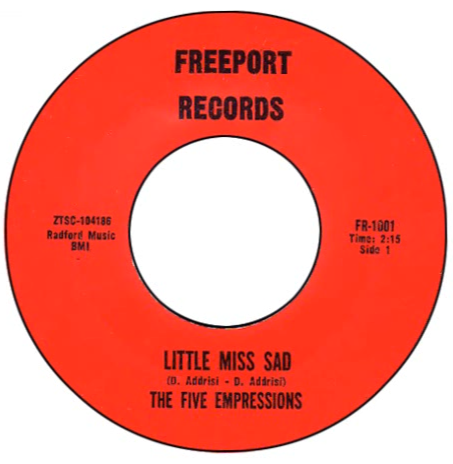
“Little Miss Sad” (1965) – The Five Empressions

“Little Miss Sad” (1965) – The Five Empressions * Written by Dick Addrisi and Don Addrisi * 45: “Little Miss Sad” / “Hey Lover” * Label: Freeport

From Benton Harbor, Michigan, this thumping, not-sad-but-happy cover of a 1964 non-charting Addrisi Brothers A-side climbed to #74 in Billboard the following year. Radio station WLS in nearby Chicago had spun the small-label track enough to blast it into the over-achievement zone. The Five Emprees (originally the Five Empressions on the single’s first pressing until Curtis Mayfield’s established trio said “ahem”) probably needed a larger label to take them to the next step, but a few more effervescent recordings like this one also wouldn’t have hurt. Later pressings of “Little Miss Sad” credited to the Five Emprees were re-recordings with added horns.
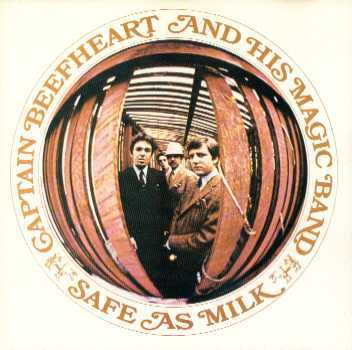
“Abba Zabba” (1966) – Captain Beefheart and His Magic Band


“Abba Zabba” (1966) – Captain Beefheart and His Magic Band
* Written by Don Van Vliet * LP: Safe as Milk * Produced by Bob Krasnow and Richard Perry * Label: Buddah

“Abba Zabba” foretells the hypnotic, jungle-chant quality Beefheart would bring to his future catalog. But its vocal patter also brings to mind eighties celebrity reports locating Beefheart as a Jack Nicholson-style regular at Los Angeles Lakers games, where he presumably classified the rhythms of bouncing basketballs as a distinct musical genre. So the late Beefheart resembled the old one; he “jumped in a circle,” like the farmer in his “Floppy Boot Song.”

“Old Man” (1967) – Love

“Old Man” (1967) – Love * Written by Bryan MacLean * LP: Forever Changes * Produced by Bruce Botnick and Arthur Lee * Label: Elektra

Love’s Forever Changes album came out in 1967, and its virtual non-reception led toward the classic lineup’s dissolution. The band, of course, had its issues with drugs and chief songwriter Arthur Lee’s infamous reluctance to tour. But the music too, with its offbeat lyrics about “the times,” lush orchestrations, and epic song structures, required some years to catch on. By the ’70s it had become a beloved cult classic, more potent as a relic than as a contemporary statement. Among the oddest tracks on the already-odd album was Bryan MacLean’s “Old Man”—the only one not sung by Arthur Lee. It features unpredictable chord changes and melody lines with a timid lead vocal that sounds as though MacLean is imitating a Scotsman. And the lyrics, about an aged mentor who gives the singer words of wisdom and a mysterious leather book, ring with vintage, pre-1968 quaintness. Later demo recordings of the song by MacLean find him really belting it out and losing the accent.

“Neighbor Neighbor” (1966) – Jimmy Hughes

“Neighbor Neighbor” (1966) – Jimmy Hughes * Written by Huey Meaux * 45: “Neighbor Neighbor” / “It’s a Good Thing” * Label: Fame

With his fan base in Houston and New Orleans, it was fitting that “Steal Away” Jimmy Hughes would also chart with a song written by Crazy Cajun Records’ Huey Meaux. “Neighbor Neighbor” (1966) reached #4 on Billboard’s R&B chart and #65 on the Hot 100, and captures Percy Sledge’s Alabama cousin sounding like Little Willie John’s rock and roll twin. In 1970, after a few unsuccessful years on Stax/Volt, Hughes would lose patience with the music industry and abandon it for a job with the nuclear industry in Tennessee.

“The Dis-Advantages of You” (1967) – The Brass Ring

“The Dis-Advantages of You” (1967) – The Brass Ring * Written by Mike Leigh * Produced by Steve Barri * 45: “The Dis-Advantages of You” / “The Dating Game” * LP: The Dis-Advantages of You * Label: Dunhill * Charts: Billboard Hot 100 #36


A 1966-67 TV ad campaign for Benson & Hedges 100’s focused on the extra long cigarettes’ disadvantages, making for situational giggles. The commercial was popular enough for the alluring musical backdrop to get some airplay on its own. Written by Mitch Leigh, the same man who scored the Man of La Mancha musical, the genuine as-heard-on-television article made enough noise in Cleveland to chart locally and to get listed in a 2/11/67 issue of Billboard as a potential breakout hit. This record was credited to “The Answer” on the red Columbia label, and the arrangers are listed as “Music Makers,” aka Leigh’s own production house. (Joel Whitburn’s Top Pop Singles erroneously cites Bill Dean and John Campbell as the songwriters.) Another arrangement of this song, by Phil Bodner’s studio assembly the Brass Ring, entered the charts a week earlier on the Dunhill label with the hyphenated title “The Dis-Advantages of You” (and an arrangement of the “Dating Game” theme on side B). Peaking at #36, it won the battle of the jingle singles, outpacing the original as a full-blown Top 40 hit.

“Superstar” (1969) – Murray Head with the Trinidad Singers

“Superstar” (1969) – Murray Head with the Trinidad Singers * Written by Andrew Lloyd Webber and Tim Rice * 45: “Superstar” / “John Nineteen Forty-One” * LP: Jesus Christ Superstar (1970) * Produced by Andrew Lloyd Webber and Tim Rice * Label: Decca * Charts: Billboard #14; UK: #47

The 1969 leadoff single for Andrew Lloyd Webber and Tim Rice’s ambitious rock opera starring the Son of God did its part in generating anticipation for an album that wouldn’t hit shelves until late 1970. The single sleeve attributes the track as coming “from the Rock Opera ‘Jesus Christ’ now in preparation.” The single would enter the US Billboard charts three separate times between 1970 and 1971, and appeared on the UK singles chart as late as 1972. A promo clip featuring vocalist Murray Head, who would be Judas Iscariot in the musical and who had recently starred in a London run of Hair, shows him climbing around cathedral ruins and singing alongside a chorus of six women billed as the “Trinidad Singers.” Its early association with the “Respect” or “Oh Happy Day” tradition ought not to be discounted as a broad appeal factor.

“Heisser Sommer” (1968) – Chris Doerk and Frank Schöbel

“Heisser Sommer” (1968) – Chris Doerk and Frank Schöbel * Written by Gerd Natschinski and Jürgen Degenhardt * East Germany LP: Heisser Sommer * Label: Amiga

The East German film Heisser Sommer (hot summer) masquerades as a Beach Blanket Bingo knockoff but is at heart a cultural missive in which the “need for restraint” and the “good of the group” are reigning concepts. With its brash musical numbers, rich colors, and pretty cast, it makes for weirdly mesmerizing viewing. The Heisser Sommer title song lingers thanks to a high and shimmering string arrangement. This was a popular technique since the days of Percy Faith, but by the late sixties/early seventies it came into vogue to express deep emotion (Delfonics, “La La Means I Love You,” 4 Seasons/Walker Brothers, “The Sun Ain’t Gonna Shine Anymore”), mystical ethereality (Spirit, “Taurus”), desertion (Ennio Morricone, “Una pistola per Ringo”), decay (Johnny Rivers, “Poor Side of Town”), foreboding (Temptations, “Papa was a Rolling Stone”). Those last three concepts—desertion, decay and foreboding—are likely what you’ll hear telegraphed loudest, though, when you watch those kids shout out their opener on the streets of East Berlin.

“O-O I Love You” (1967) – The Dells


“O-O I Love You” (1967) –  The Dells * Written by Bobby Miller * Producer: Bobby Miller * 45: “O-O I Love You” / “There Is” * LP: There Is * Arranger: Charles Stepney * Label: Cadet * Charts: #61 (Billboard Hot 100); #22 (Billboard R&B)

In the late sixties, the Dells came into clearest focus when the Chicago doo wop vets updated two of their earlier hits, “Oh What a Night” (1956) and “Stay in My Corner” (1965), transforming them into showcases for the group’s pleading, seamless vocal interchanges against the starry, shimmering backdrop of Charles Stepney’s instrumental arrangements. Those two tracks, especially the full six minutes of “Stay in My Corner,” may be the ultimate Dells experiences, but an earlier one called “O-O I Love You” previews the highly-charged, emotionally drawn-out direction they were headed toward. When the hammy basso recitation by Chuck Barksdale begins (“and…uh…words are born”), you assign it to the throwback throwaway category. But then lead tenor Johnny Carter takes over and you lose yourself and drift off to the aching, majestic bridge. Lead baritone Marvin Junior then emerges with a burst of fireworks, setting up a final recitation by Barksdale, who now sounds entirely seductive. Junior and Carter then close things out with more dueling fireworks before fading into the silence of the stunned.

“Mindbender (Confusion’s Prince)” (1965) – The Grateful Dead

“Mindbender (Confusion’s Prince)” (1965) – The Grateful Dead * Written by Jerry Garcia and Phil Lesh * LP: Birth of the Dead  (2003) * Producers: Tom Donahue, Bobby Mitchell * Label: Rhino

The five original members of the Grateful Dead recorded their first demos as The Emergency Crew at Golden State Recorders on Harrison Street (two blocks away from where the Giants now play). This was the studio of choice for Autumn Records, co-owned by legendary disk jockey Tom Donahue, which had generated the first conception of a “San Francisco sound” with the misty jangle of the Beau Brummels. Although the future Dead had already generated a live buzz as the Warlocks, they scrapped the name for the sessions, having gotten wind of another band already recording under that name. The six demos are true curiosities, sporting a decidedly Autumn sound and a short-lived intra-band understanding that bassist Phil Lesh would serve as a primary vocalist. The track “Mindbender,” in particular, follows a trail through the minor-key moods of early Beau Brummels into the espionage exotica of Monty Norman’s “James Bond Theme,” a 1964 US radio hit for Billy Strange.

“Yamaha Mama” (1966) – Gary McFarland and Gabor Szabo

“Yamaha Mama” (1966) – Gary McFarland and Gabor Szabo * Written by Gabor Szabo * LP: Simpatico * Producer: Bob Thiele and Gary McFarland * Label: Impulse

On the cover of their 1966 Simpatico album, vibraphonist Gary McFarland (left, Yamaha YA6) and guitarist Gabor Szabo (right, 250 Big Bear) – both of whom left this world before their time – look like they’ve gotten lost. Listeners of music such as this, though, with its guitars and incantations channeled in from the ether where Szabo and McFarland presently ride their space bikes, are the ones who run an ongoing, larger risk of getting lost in the two musicians’ otherworldly sounds. Producer Bob Thiele, always on the hunt for a commercial tie in during his tenure at Impulse, likely had a hand in choosing this track’s title and photo concept.